As
a biodegradable packaging bag manufacturer certified with ISO 9001
Quality Management System, we provide custom garment packaging bag
solutions compliant with US and EU environmental regulations for global
fashion brands, based on 16 years of experience in the apparel packaging
industry. This guide provides an in-depth analysis of technical
requirements for garment packaging bags, environmental material
standards, and customization processes, helping brand owners establish
sustainable packaging supply chain systems.
Garment
packaging bags, as essential carriers for product protection and brand
communication, must meet the stringent requirements of ISO 21800-2:2019
Textile Packaging Materials Standard. According to the 2024 industry
report by The Textile Institute, high-quality garment packaging bags
should meet the following core performance indicators:
Tensile Strength: ≥30MPa (longitudinal) and ≥25MPa (transverse)
Elongation at Break: ≥150%
Water Vapor Transmission Rate: ≤800g/(m²·24h)
Tear Strength: ≥40N
Heavy metal content complies with REACH Regulation Annex XVII Restricted Substances List
Plasticizers (DEHP, DBP, BBP) content below 0.1%
Formaldehyde emission compliant with Oeko-Tex Standard 100
According
to ISO 12647-2 Process Control for the Production of Halftone Colour
Separations, Proof and Production Prints, garment packaging bag printing
must meet:
Registration accuracy: ±0.15mm
Color difference value: ΔE≤3.0
Adhesion test: 4B level or above
With
the implementation of EU Single-Use Plastics Directive (EU 2019/904)
and US Recyclable Products Identification Act, the material selection
for garment packaging bags directly impacts brand market access. We
offer two biodegradable material solutions certified by authoritative
international standards:
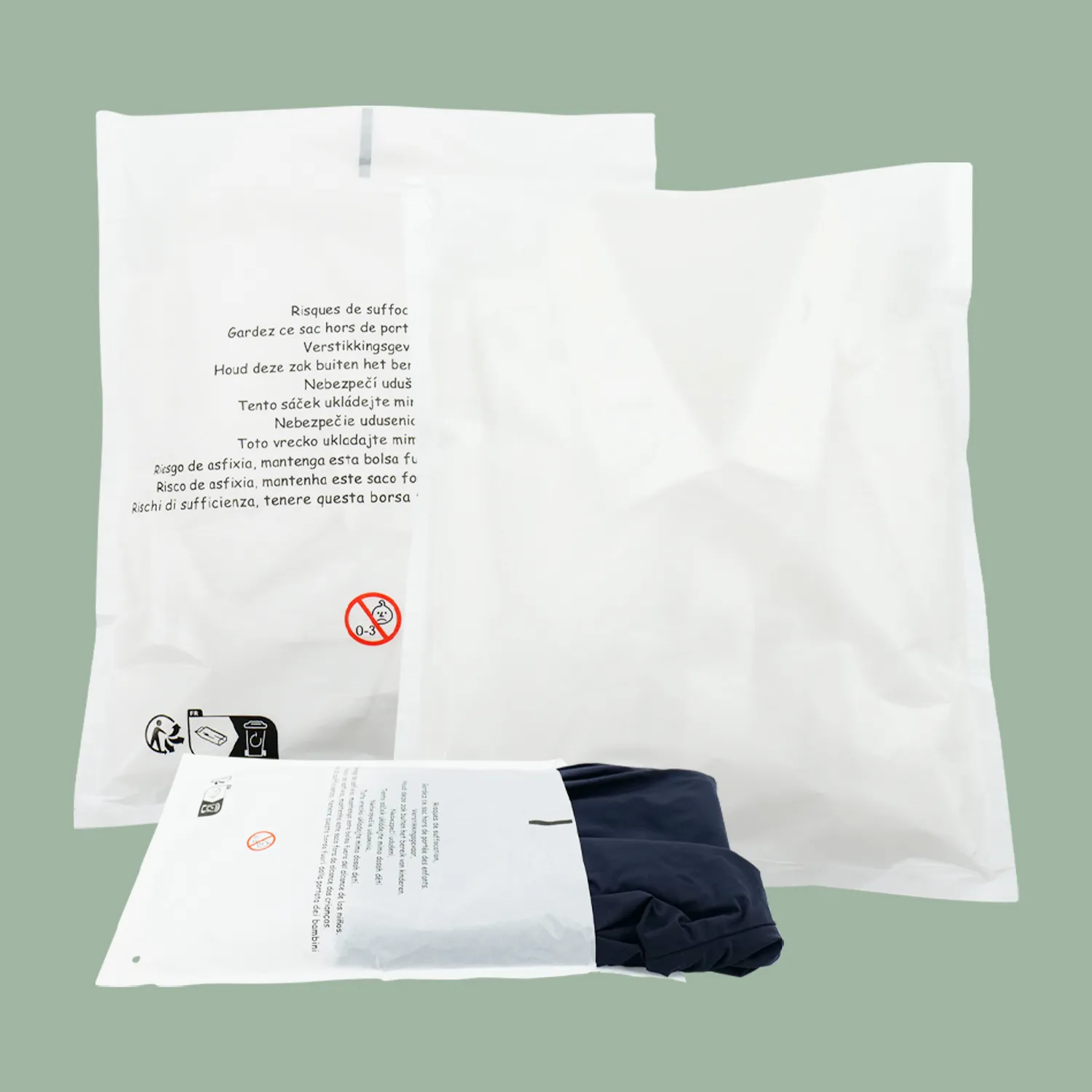
PLA
(Polylactic Acid) is a bio-based polymer synthesized by fermenting
renewable resources such as corn starch and sugarcane, accounting for
45% of the global biodegradable plastics market (according to European
Bioplastics 2024 data). PBAT (Polybutylene Adipate Terephthalate), as an
aliphatic-aromatic copolyester, effectively improves the brittleness of
PLA, achieving performance balance.
Based
on our collaborative research with the Institute of Textile Technology
(ITA) at RWTH Aachen University, Germany, a PLA:PBAT=70:30 ratio can
achieve:
Industrial Composting Conditions: Biodegradation rate >90% within 180 days
Mechanical Performance Optimization: Impact strength increased to 3 times that of pure PLA
Processing Window Expansion: Extrusion temperature range 160-190°C
Our PLA+PBAT materials have obtained the following authoritative international certifications:
| Certification Body | Certification Standard | Certification Scope | Validity |
|---|
| DIN CERTCO | EN 13432 | Industrial Compostable | 2023-2028 |
| BPI | ASTM D6400 | US Biodegradable Plastics Standard | 2024-2029 |
| TÜV Austria | OK Compost HOME | Home Compostable | 2023-2027 |
| FDA | CFR 21 Part 177 | Food Contact Material Certification | 2022-2027 |
For brands seeking ultimate environmental performance, we offer 100% recyclable fiber materials:
Raw Material Source: Eco-Certification wood pulp, ensuring sustainable forest management
Grammage Specifications: Three specifications available - 80g/m², 100g/m², 120g/m²
Bursting Strength: ≥200kPa
Recyclability: 98% (according to European Paper Recycling Council CEPI standards)
Organic Cotton Certification: GOTS (Global Organic Textile Standard) Version 5.0
Linen Content: ≥30%
Biodegradation Cycle: 6-12 months under natural conditions
Reusable Times: ≥50 times (based on LCA Life Cycle Assessment)
Based
on technical guidelines from European Bioplastics, we recommend brand
owners select materials based on the following factors:
Scenarios for Choosing PLA+PBAT:
Target markets include EU, US, Canada with clear regulations for biodegradability
Products require higher barrier properties (moisture resistance, dust resistance)
Bulk production costs controlled within reasonable range
Brand image emphasizes "technological environmental protection"
Scenarios for Choosing Fiber Materials:
Luxury or high-end fashion brands emphasizing natural texture
Target consumers with extremely high environmental awareness (e.g., Nordic markets)
High reusable value of product packaging
Brand image emphasizes "circular economy"
Based
on our customization service experience with 500+ fashion brands
worldwide, five key parameters must be clarified before customizing
garment packaging bags to avoid production delays and quality issues.
MOQ (Minimum Order Quantity) Strategy:
| Order Quantity Range | Application Scenario | Price Coefficient | Production Cycle |
|---|
| 1,000-5,000 pcs | New brand market testing, sample verification | 1.8-2.0 | 15-20 days |
| 5,000-20,000 pcs | Seasonal new products, standard bulk | 1.3-1.5 | 12-15 days |
| 20,000-50,000 pcs | Long-term cooperation customers, scaled production | 1.0-1.2 | 10-12 days |
| 50,000+ pcs | Strategic partnership | 1.0 | 7-10 days |
Cost Optimization Recommendation:
According to our production data analysis, when batch volume exceeds
20,000 pieces, unit cost can be reduced by 40% due to material
procurement discounts and improved equipment utilization.
File Format: Vector format preferred (AI, EPS, PDF), bitmap ≥300DPI
Color Mode: CMYK four-color printing, spot colors require Pantone color numbers
Bleed: Reserve 3mm bleed on all sides
Safe Margin: Text and LOGO ≥5mm from edges
| Printing Process | Applicable Order Quantity | Color Reproduction | Per-Color Cost | Production Speed |
|---|
| Gravure Printing | ≥10,000 pcs | ★★★★★ | Low | High (300m/min) |
| Screen Printing | 1,000-10,000 pcs | ★★★★ | Medium | Low |
| Flexographic Printing | ≥5,000 pcs | ★★★★ | Low | Medium-High |
| Digital Printing | ≤5,000 pcs | ★★★★★ | High | High |
Eco-Friendly Ink Options: We offer two eco-friendly ink options - soy ink and water-based ink, both compliant with EcoLabel environmental certification.
Based
on the standard size database of the American Apparel & Footwear
Association (AAFA), we provide the following common size specifications:
Standard Garment Packaging Bag Sizes:
T-shirts/Polos: 30cm × 40cm ±2mm
Shirts/Light Jackets: 35cm × 48cm ±2mm
Suits/Thick Jackets: 40cm × 55cm ±2mm
Dresses: 35cm × 55cm ±2mm
Accessories Packaging: 15cm × 20cm ±1.5mm
Special Size Customization: For non-standard sizes, we provide 3D modeling services to ensure packaging-product matching rate reaches over 95%.
Transparent Type: Light transmittance ≥85%
Translucent Type: Light transmittance 50-70%
Beige: Pantone 460C
Light Gray: Pantone Cool Gray 2C
Support full color number customization from Pantone color cards, commonly used color suggestions:
Brand Colors: Pantone 186C (Classic Red), Pantone 286C (Royal Blue)
Natural Tones: Pantone 413C (Earth Brown), Pantone 576C (Forest Green)
Color Difference Control Standard: ΔE≤2.0 (Color difference grade AA)
| Closure Type | Application Scenario | Moisture Resistance | Reusable | Additional Cost |
|---|
| Self-Sealing (Adhesive Strip) | Products requiring multiple access | ★★★ | Yes | +8% |
| Heat Sealing | One-time packaging, high moisture resistance requirements | ★★★★★ | No | 0% |
| Zipper Closure | High-end brands, emphasizing environmental protection | ★★★ | Yes | +15% |
| Tuck-In Folding | Simple packaging, cost-sensitive | ★★ | Yes | +3% |
Technical Note:
Self-sealing uses pressure-sensitive adhesive made from biodegradable
PE film, adhesive strength ≥3N/25mm, compliant with ASTM D3330 standard.
Founded: 2015, focused on R&D and production of biodegradable packaging materials
Brands Served: 500+ fashion brands, covering 30+ countries in Europe, North America, Southeast Asia
Annual Capacity: 80 million square meters, production equipment from Brückner (Germany) and Toshiba (Japan)
R&D Investment: 8% of annual revenue invested in R&D, holding 20 biodegradable material-related patents
ISO 9001:2015: Quality Management System Certification (SGS certified)
ISO 14001:2015: Environmental Management System Certification
BRCGS: Global Food Safety Standard Certification (applicable to food-grade packaging)
SEDEX: Social Responsibility Ethical Trade Certification
RWTH Aachen University, Germany (ITA): Joint development of PLA modification and composite technology
French Alternative Energies and Atomic Energy Commission (CEA): Biodegradation testing technology cooperation
Michigan State University School of Packaging, USA: Sustainable packaging design research
Based on ISO 10007 Configuration Management Standard, we have established a standardized customization process:
Phase 1: Requirement Confirmation (1-2 days)
Confirm five-dimensional parameters (quantity, printing, size, color, closure)
Provide design proposal and cost quotation
Sign contract and pay deposit (30%)
Phase 2: Sample Production (3-5 days)
Create PP samples (printing proofs)
Create physical samples after PP approval
Customer confirms sample quality
Phase 3: Mass Production (10-15 days)
Material procurement and production scheduling
Production process quality monitoring
Finished product inspection and packaging
Phase 4: Logistics Delivery (7-10 days)
International logistics solution selection (sea freight/air freight)
Customs clearance document preparation (Certificate of Origin, Test Reports)
Product delivery and acceptance
According
to McKinsey's 2024 "Sustainable Packaging Trends Report," the global
biodegradable packaging market will reach $45 billion by 2030, with a
compound annual growth rate of 18.7%. The garment packaging industry is
undergoing a critical transition from traditional plastics to
biodegradable materials.
Key Trends:
Regulatory-Driven: EU has completely banned single-use plastic packaging, California AB 793 requires 30% recyclable packaging materials
Consumer Preference: 83% of consumers willing to pay 5-10% premium for eco-friendly packaging (Nielsen 2024 research)
Supply Chain Transparency: Brand owners increasingly require traceability of packaging materials
Our
technical team continuously monitors global environmental regulatory
dynamics, regularly updates material certification systems, ensuring
customer products always comply with the latest requirements of target
markets.
Contact
us for professional technical consultation and customization solutions.
Our team of technical engineers will respond within 24 hours to your
needs, providing comprehensive services including material selection
recommendations, cost optimization solutions, and production cycle
planning.
Let
us jointly drive the fashion industry's transition to sustainable
packaging, using professional technology and certification standards to
establish green supply chain competitive advantages for your brand.